


Osprey Publishing
Silver Hill Barracks
Napoleonic Activity in Sussex
By Chris Butler
Sussex was on the frontline in the war with Revolutionary and Napoleonic France. Numerous barracks and camps were constructed across the County, together with fortifications, gun batteries and Martello Towers, and there was a huge influx of soldiers and militia for training and defensive purposes. In this first article we will look at the investigations into a Napoleonic Barracks.
Blatchington Barracks, situated to the west of Seaford town on the East Sussex coast, was built in 1794, and became associated with the Experimental Corps of Riflemen, the predecessors of the 95th Rifles, when they were based there in 1800[1]. In March 1801, whilst there, the new establishment for the Rifle Corps Regiment was laid down. The Rifle Corps transferred to Chatham in Kent in 1802 and then becoming the 95th Rifles at Shorncliffe, Kent in January 1803.
Unfortunately, all trace of Blatchington Barracks has been lost, with the area now covered with housing. Similarly, Bexhill Barracks, where the 2/95th were based in 1806, has also been covered with housing, although Bexhill is better known for its association with the Kings German Legion. Almost all trace of the other barracks and camps across Sussex has gone, although from time to time archaeological work reveals evidence of these former camps.
[1] Summerfield, S. & Law, S. 2019 The Baker Rifle and the early Campaigns of the 95th Rifles, Ken Trotman Publishing
Fig. 1: Silver Hill Barracks on the 1808 OS Map
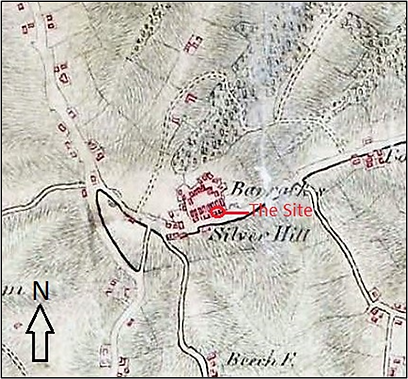
Silver Hill Barracks near Hurst Green, East Sussex is first shown on the 1798 OS map with the initial layout of a centrally placed open parade ground surrounded by a rectangular arrangement of buildings, built in that year for c.4,000 men. Documentary evidence[1] suggests the SilverhHill barracks took eight weeks to complete and was the largest in the county. These early barrack structures often took the form of wooden sill foundations having prefabricated wooden wall sections, weatherboarding and a tiled, slated or thatched roof[2]. On the 1808 OS map (Fig. 1) the barrack buildings have become more extensive across the site. At this time, a barrack list showed a compliment of 2,132 officers and men from the infantry were present with the barrack master being Lieutenant Sir J Shuckburgh[3]. The 1813 OS map shows little change to the site, and the barracks were closed in 1815.
An archaeological watching brief carried out by my company in 2019 found remains of the Silver Hill Barracks[4]. A structure comprising a robbed out rectangular foundation trench (Fig. 2) with some of its original building material intact, including an in-situ sandstone cornerstone, probably represents a barrack building (Fig. 3). The finds from the excavation suggests more than one phase of building/rebuilding. A rectangular pit was located within this structure and a comparative lack of building material retrieved from this feature suggests it may not have been structural. Two drainage ditches which ran into a soakaway pit were lined with ceramic tile (Figs. 4 & 5) and the finds assemblage suggests one is earlier than the other. A third drainage ditch, unlined, runs from the structure to the soakaway pit. It is tentatively suggested that this building represents the remains of a latrine, with the central pit representing its cess pit.
[1] Sussex Weekly Advertiser. 28/05/1798
[2] Hudson, A. Napoleonic Barracks in Sussex: Sussex Archaeological Collections Vol.124 (1986)
[3] Report: Napoleon Series, 1808 barrack list, 2009
[4] Walsh, E. 2020 An Archaeological Watching Brief at Stage Field, Silver Hill, Hurst Green, East Sussex.
CBAS Ltd Report 1082
Fig. 2: Remains of the building
(The dark lines are the robbed-out wall foundations)


Fig. 3: The Excavation
Fig. 4: Drain formed of brick and tile

A large assemblage of stone, brick and tile, with a lesser component of mortar, slate and glass demonstrate that at least some of the barracks’ structures became more permanent, perhaps having brick or sandstone foundations and brick walls, an upper timber frame and the roof covered with ceramic or slate tiles. This is significant as prior to the Napoleonic era permanent military barracks were rare [1].
The finds assemblage, particularly the metal work, is strongly indicative of a military origin. Objects such as buttons, buckles and musket balls represent military paraphernalia being carried, and lost, within the barracks while a clay marble and a Jews harp possibly demonstrate the ways in which the soldiers spent their free time (Fig. 6). Pottery and clay tobacco pipes are all of the period 1790-1820. Glass is rare. A small assemblage of animal bone suggests sheep and cattle formed part of the soldiers diet.
The finds assemblage indicates activity on Site ceased c. 1820, and the buildings were removed. This is in keeping with the fate of many Napoleonic barracks which went out of use around 1815 at the end of the Napoleonic War and were dismantled, the materials being resold.
[1] Military Structures: Listing Selection Guides. English Heritage. 2011.
Fig. 5: Ceramic drain

Artefactual evidence indicates that the 13th and 50th Regiments of Foot were stationed at the barracks at some point. The 13th Foot were briefly in England in 1798 before going to Ireland and then Egypt, they were then stationed in the Mediterranean until 1805 when they returned to England. After occupying various stations in the south of the country, they sailed for Ireland in May 1807 before sailing to the West Indies and later America where they remained for the rest of the Napoleonic Wars. Thus, they may have been stationed at Silverhill at some point between 1805 and 1807 or in 1798/9.
The 1st Battalion of the 50th Foot were abroad and then in Ireland before serving in the Peninsular in 1808, Walcheren in 1809 and then back in the Peninsular from 1809 to 1814, when they returned to Ireland. They could have stayed at Silverhill between their deployments in the 1804 to 1810 period, however, the 2nd Battalion of the 50th Foot, newly raised in 1804, served as a home-based unit and does not appear to have served abroad, other than possibly providing drafts for the 1st Battalion, and perhaps is more likely to have been stationed here than the 1st Battalion, however, for the most part they were known to have been quartered at Eastbourne and Pevensey [1].
As the barracks could take up to 4,000 soldiers, and a normal Battalion probably only had around 800 men, it is very likely that other units, including militia as noted above, were stationed at the Barracks through its existence. The 95th may have had detachments there or could have stopped over at Silver Hill during their transfer from Blatchington to Chatham in 1802.
[1] Fyler, Colonel Arthur Evelyn. The History of the 50th Or (the Queen's Own) Regiment from the Earliest Date to the Year 1881. London: Chapman and Hall. 1895
Fig. 6: Top Row, from left to right: Part of Curved Trigger Mechanism (2 x) from Brown Bess, Jew’s Harp, Military Oval Framed Buckle, Military Rounded Rectangular Buckle (broken), Military Oval Framed Buckle. Bottom Row, from left to right: - Silvered or Tombac metal button, Domed Metal Button, Somerset Regiment, Large Crown Domed Metal Button, Somerset Regiment, Round Domed Metal Button, Crowned 50, lion atop, Musket Balls (3x), Gun Flint.
